

.png)

PLAY
What is in this Section
Introduction
“The world of play encloses the player in a sphere that captures all his or her attention and places him or her in a universe shielded from all outside demands and constraints….Belonging to this universe generates a ‘feeling of experiencing the exceptional together, of sharing something important together, of separating ourselves from others together, and of escaping from general norms’”
(Huizinga, 1951, p. 33 as cited in L’Aoustet & Griffet, 2004, p.181).
In describing the youth's experience of the Borely Park in France, L’Aoustet and Griffet (2004) identify parks as a place that binds youth under the idea of play, which frees them from general norms. The desire to dissociate themselves from the general norms is especially strong among Japanese youth, who engage in their subcultures "[to] seek fun and youthfulness...especially aim[ing] to express a strong divide between them and the mainstream, including their parent generation" (Park, 2010, p. 18). Being a youth-specific activity, play becomes "[a] reality over which [youth] do have control and are at the center of" (Daliot-Bul, 2014, p. 136) and it is this sense of "distinction from mainstream (adult) culture and its internal coherence [which] help define the members' personal identity and enhance feelings of belonging" (Buchmann, 2001, p. 16660). In other words, youth create their identity by differentiating themselves from the general norms while also being with other youth who they share the same value with.
While L’Aoustet and Griffet (2004) use the idea of play in terms of the activity itself, Benett (2015) furthers this idea by stating that “youth’s spatialization of the city may not be restricted to such recognized flows of leisure and consumption but may take on different dimensions in which new emotional and aesthetic cartographies of space and place come into being” (p. 780-781), stating that it is not only the activity itself, but also how the activity is performed in a certain place that creates the identity of youth. Taken together, making Miyashita Park as a place for play, youth interact with other youth to create their own community, through which they establish an emotional connection with other similarly-placed youth to strengthen their identity. In other words, by engaging in different kinds of play, youth "[show] off their belonging to a subculture of which they are extremely proud" (Park, 2010, p. 19).
Types of Play

Right at the bench area in front of the center staircase of the Miyashita Park, a group of guys consisting of four guys with casual outfit of T-Shirt and jeans are chilling, with their to-go drink on the bench. They seem to be somewhere around the age of university students. There comes two younger boys around the age of high school dressed in sporty clothes with Nike backpack, as if they are going to start playing soccer at any second. They sit on the other side of the bench from where the guys are sitting and start eating their food they took with them from the food court downstairs, casually eating it with their hands while talking. Just as one of the boys goes down stairs to return the tray of the food, one of the older guys starts talking to the boy and they start engaging in conversation altogether once the boy comes back. Despite the fact that one of the boys does not speak Japanese, the older guys keep trying to speak in English, overcoming the barrier of language to engage in stranger interaction. They start exchanging their Instagram, talking eyes to eyes and laughing. They seem to be talking about sports. One of the boys and one of the guys stand up, with a ball in the boy's hand, running toward the direction of the sand park.
1. Sports
Right at the bench area in front of the center staircase of the Miyashita Park, a group of guys consisting of four guys with casual outfit of T-Shirt and jeans are chilling, with their to-go drink on the bench. They seem to be somewhere around the age of university students. There comes two younger boys around the age of high school dressed in sporty clothes with Nike backpack, as if they are going to start playing soccer at any second. They sit on the other side of the bench from where the guys are sitting and start eating their food they took with them from the food court downstairs, casually eating it with their hands while talking. Just as one of the boys goes down stairs to return the tray of the food, one of the older guys starts talking to the boy and they start engaging in conversation altogether once the boy comes back. Despite the fact that one of the boys does not speak Japanese, the older guys keep trying to speak in English, overcoming the barrier of language to engage in stranger interaction. They start exchanging their Instagram, talking eyes to eyes and laughing. They seem to be talking about sports. One of the boys and one of the guys stand up, with a ball in the boy's hand, running toward the direction of the sand park.
Right at the bench area in front of the center staircase of the Miyashita Park, a¥
In describing the experience of the park, L’Aoustet and Griffet (2004) claim that the park is a place of playing together and sharing experiences, which is reflected in their example of youth gathering to play soccer together.
Just like the quotes show, sports can be a binding element, especially in parks, that is made as a space for play. The guys and the boys in the example above also engage in stranger interaction, spurred by the idea of playing sports together. Being part of the youthful activities with those who are interested in the same sports, these youth embrace their status as youth while also identifying themselves as part of a specific group.
“A little further away in a large grassy area, 10 or so boys are engaged in a soccer game. The group is made up of several young adolescents and one adult who is organizing the game (the father of one of the players). Taking advantage of a ball that goes out of bounds, two boys in soccer jerseys approach the group and ask if they can join in. The answer is yes. Each team gets a new player”
(L’Aoustet & Griffet, 2004, p.179).
2. Music
Especially in front of the central stairs, there are youth playing music out loud at night. Breaking rules of avoidance, these youth play music to bring happiness to people as the quote on the right shows. Those who like the taste of the music come closer to listen to the music and they eventually start engaging in conversation, talking about the kind of music they like, eventually diminishing strangeness to even start engaging in casual conversation. Here, music becomes the trigger for stranger interaction among those who share the similar taste in music. Although playing music out loud can be seen as an annoyance in other parts of the city, it is tolerated and even welcomed by youth in Miyashita Park, who all gather to liberate themselves from the mainstream value. It is through music, that these youth differentiate themselves from other generations while also finding and uniting with other youth who they share the similar taste with.
“皆さんにハッピーになってもらえたらいいなって
(I hope to make everyone feel good through music)”

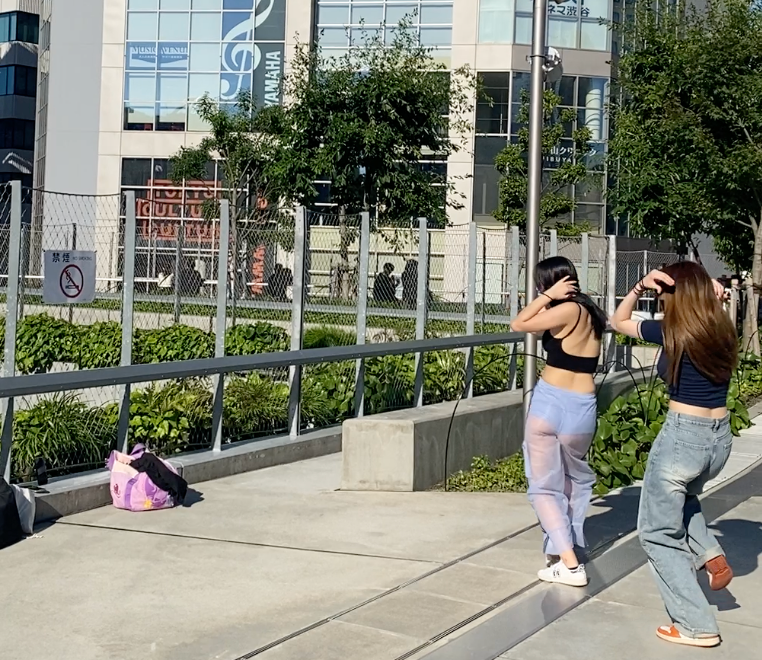
The girls dancing
Other TikTokers nearby turning back to look at the girls on the left picture dancing
Two young girls are dancing right next to the big staircase on the rooftop with their phone on the ground filming them as they dance. The other TikTokers that occupy in front of the staircase cannot help but look at their dance with their head tilting toward them. The girls keep dancing and dancing proudly…
3. TikTok
Many youth, especially girls, make TikTok videos on the rooftop of Miyashita Park. While these youth may not engage in verbal communication, they communicate more than just engaging in civil inattention (which is how people normally go about interacting with others nonverbally, paying attention just enough to acknowledge their existence to respect their personal space (Karp, 2015)) as they observe what kinds of videos other TikTokers are making, getting idea of what they can do and determining what is cool. The performers also proudly show their dances, establishing themselves as a leading figure of the TikTok community → Learn more about how youth claim their space through making TikTok in the section Consumption of Space. Extending the youth platform of social media onto the real world, these youth turn the space of Miyashita Park into a youth-specific place where they can meet and be part of other youth who are also interested in creating TikTok, forming their identity as part of the TikTok community.
Conditions of Play
Karp (2015) claims that "the usual conception of risk and uncertainty in interactions with strangers can be reduced in certain circumstances" (p. 113), identifying two factors: settings and context as the underlying condition for any stranger interaction. Using the classification of Karp (2015) as a guiding framework, this section will unpack when or under what condition the play comes into being in Miyashita Park to see how various factors influence the formation of play, through which youth dissolve the strangeness among one another and identify themselves as part of a specific group.
Karp (2015) identifies “settings” as “the social conventions governing the nature of the interactions that occur in them” (p. 113). In part, it is the general functioning of the park as an open place of play that allows youth to engage in different types of play as described above. As claimed in the history section, Miyashita Park is especially an open and free place where people can express their ideas to claim their space. In addition to being an open place, Miyashita Park is also a park that is especially under the influence of social media, which shapes the atmosphere of the park differently from other parks.
“TikTokでよく見るから、来たいなと思いました (I saw Miyashita Park a lot on TikTok and so I’ve always wanted to come here)”
“無機質な壁がインスタ映えする (The monotonic wall is very photogenic for Instagram)”
Just as the quotes reveal, social media is used as a platform to attract new youth to Miyashita Park. In this sense, there is a clear influence of social media in creating the kind of youth who visit Miyashita Park. Specifically, those who are keen on social media tend to come to Miyashita Park, thus creating a sense of community that is bounded by social media, especially TikTok and Instagram. The reason why youth who engage in TikTok intensely observe the others is due to the influence of social media and how these youth already belong to a TikTok community online. By coming to Miyashita Park and engaging in TikTok activity, these youth extend these online communities in reality, interacting with them through observing as well as performing their skills.
1. Settings
2. Context
“The context of a situation provides information that helps define the meaning of behavior. It may also indicate certain aspects of individuals' identities or details of their biographies that can make it easier to initiate interactions”
(Karp, 2015, p. 114).
As the quote reveals, Karp (2015) identifies “context” as information of others that eventually diminishes the strangeness of others. First, just as youth gather in Borely Park spurred by the idea of fun (L’Aoustet and Griffet, 2004, p. 180), youth come to Miyashita Park looking for something fun, where they can free themselves from the general norms and to express themselves as they wish. In Miyashita Park, the mutual interest in having fun unites the youth to engage in play. For instance, in the first situation above, the guys and the boys started to bridge the strangeness among them through their mutual interest in sports, diminishing strangeness and eventually playing together.In addition to the idea of fun, youth specifically choose with which youth they engage with, using commonalities as a cue.
“There is an active selection process whereby different groups of young people tend to select different types of ‘cultural elements’ over others (for example, the type of music one listens to is associated with particular kinds of audiences). In this instance, then, identity is formed through relationship to particular kinds of friends, music, family ties, choice of movies, school subjects, and so on”
(Wyn & White, 1997, p.87)
Specifically, as the quote above shows, youth engage with one another when they sense the similar vibes from what Wyn and White (1997) call “cultural elements,” which refers to the way they behave as well as dress. In the first example above, the guys started talking to the boys as they sensed that the boys play sports from the way they dressed. In the same way, youth who play music attract those who like the same kinds of music while TikTokers gather around those who also make TikTok videos. Youth naturally gather around like-minded youth, taking cultural elements like fashion and music as signals, to form their identity → Learn more about how youth use fashion to show their status in the section Material Goods.
Idea of Fun
Cultural Elements
Conclusion
As the above-mentioned types of play illustrates, youth engage in different kinds of activities, spurred by the sense of togetherness that is provided by social media, the idea of play as well as the similar cultural elements. By engaging in these conditions that are youth-specific, they differentiate themselves from adults and free themselves from the general norm of non-involvement, forming and strengthening their identity with other youth.